
Interview: Hugh Hendry
From London’s Hedge Funds to Life on St Barts

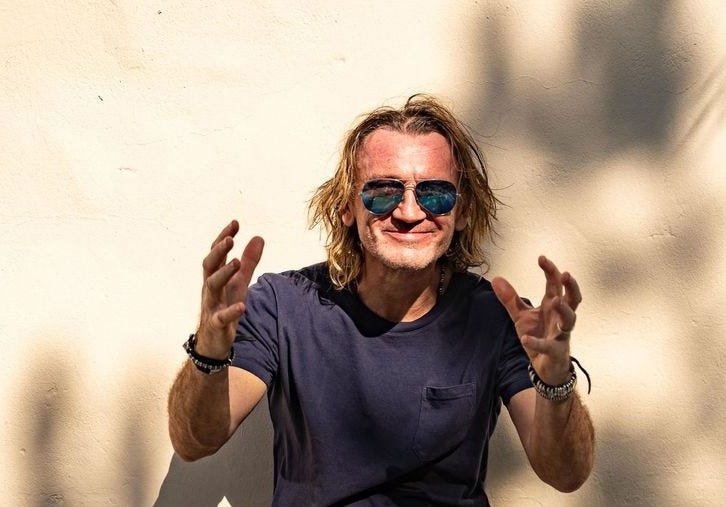
Hugh Hendry is a retired hedge fund manager from Glasgow, Scotland, and the founder of Eclectica Asset Management, which managed $1.3 billion in assets at its peak.
What follows is a transcript of our conversation, which took place on November 14, 2025. The transcript has been edited for length and clarity.
[Note: The opinions expressed by the interviewee are their own and do not necessarily represent those of the interviewer.]
Escape from Glasgow
CB: What was it like growing up in Glasgow in the era that you did? It has a reputation for being a tough place.
HH: Yeah, there are many hard places. I mean, heavens, I’ve spoken about Glasgow a lot. The striking thing for me is how I came to reject those surroundings at a very early age. I think I can trace that back to the age of 12, and normally you’d associate that with a lack of love from parents or whatever. But I don’t believe that was the case. I need sunshine in my life. There’s no sunshine in Glasgow. The sky is incredibly low and gray, and I felt suffocated by it, and it’s a great mystery to me, but I did not feel I belonged there. From a very early age, I set off on a mission to try and get out of it, and I used the very rudimentary notion that I would work harder.
I was the first kid at my school that went on to go to university. I didn’t want to do it originally, I was burnt out from all the studying to get there. But university was, again, a means of climbing the ladder. I went to university in Glasgow. I traveled from a suburb on public buses. My mother made me a sandwich. I had no money. The other kids were fearful, I looked like some kind of hooligan, I just wasn’t from the same background.
In Glasgow, I was so driven. I had no vices. I didn’t drink, I didn’t smoke, I didn’t have girlfriends, I didn’t go to parties, I didn’t have a social life. I just worked. I wish that were different. And I’m kind of trying to catch up now.
English vs. Scottish Minds
CB: As a Scot, what’s your perspective on the English? They have a lot of unwritten rules and hierarchies.
HH: By and large, I would only have positive things to say. And you’re right, yeah. Another observation from that time would be particularly between the English and the Scottish kids at university. The English had no fear of being wrong, and that can be interpreted as being arrogant. But if a question was asked, they would offer an opinion, whereas when I looked around at my peers, heads were down, people were looking at their shoes. There was a fear in offering, and there was a fear in being wrong, which the English contingent didn’t seem to have. It’s very, very powerful.
I think about things too much, perhaps, but if you were to ask me to characterize the skill set that I went on to develop as a hedge fund manager, I would say that I was a world-class loser. That I had prepared for losing. The business of speculation and thinking about tomorrow is laden with error and mistakes. And it’s much better if you’ve conceived of how you deal with your mistakes before they happen, so you’ve got a process in place, and therefore you don’t fear it. I was quite fearless, because I was such a great loser already that I had a system and a procedure, an ex ante means of thinking about what I was doing, an expectation that winning was just the bonus.
Entering the London Hedge Fund Scene
CB: You started in Edinburgh, as I read, and later moved to London. What was it like in the City in the 1990s, when you arrived?
HH: The funny thing is, I worked in Edinburgh for eight years, and I was very unsuccessful. I was working for a very, very successful company called Baillie Gifford, you were talking about the English, it was an English-dominated company. It was that social hierarchy, with people that had come from money, often for many generations. It was completely alien to me. They were expanding into the American corporate pension schemes. And one of the pushbacks was the lack of, if you will, gene diversity in their recruitment. Literally, they hired me because I wasn’t them, and for whatever reason, it didn’t click. They never fire people. To them that would be filthy. So they kept me along until I just had to leave.
Now, what had kept me away from London was a preposterous social mistruth in Scotland, that living in London was appalling, like you had to get up at 4:00 a.m. The nonsense that people propagate. Again, it hints at all the half-truths that are necessary to keep tribes in line and to keep people passive and far from restlessness. I can look back and see how I was enslaved by some of these slogans. I lived in Notting Hill. I lived in West London, and I worked in West London initially. I worked for another partnership, and that was in Mayfair. That was a classic hedge fund.
I would cycle from Notting Hill. It would take 15 minutes. I’d have a little Bloomberg pager on the basket of my bike, and I could click and see the eurodollar price, whatever, preposterous. I loved Notting Hill. I love community, small places where everyone kind of knows you. Now, my hedge fund, and the way I traded, created a huge amount of commission and profit for investment banks that I was largely oblivious to. I just traded all the time, and when my day was finished, I went home and read. I had a young family, so I didn’t go out. I didn’t see the big city aspect of London.
I’ve always lived within my head. I’m a time traveler, and inside my head, I’m in the future. At the time, I thought I didn’t like London. But no, London’s a great place. If I’m not in St Barts, I’m in London, Paris, LA, West Hollywood, Tokyo, and Soho in New York.
Finding a Mentor
CB: Who were your most valuable mentors in life? I understand you were recruited by Crispin Odey. I’ve read a bit about him. And just in terms of his investing approach, he sounds like a very exciting person to work around.
HH: Well, I mean, he is second to none. He is the Atlas, the most extraordinary figure I think I will ever meet. And the thing that I most respect was, this sounds a bit up my ass, but I respect his courage in employing me and the logic for why he chose me: troublemaker. We met under circumstances where you would reach out for that word serendipity. I was working at Credit Suisse Asset Management. They had an investment in his European equity mutual fund. My boss, who had hired me, was due to attend. He was ill, and he instructed me to attend in his absence.
I attended that meeting feeling suicidal. This marked the lowest point in my professional career. This would have been eight or nine years after I left university, and here I was, literally kicking stones on the streets of London, going to his office, saying, “This is what I’ve become.” I take notes on fund managers. I’m not the fund manager. I’m the guy who sits there like, “Oh, sorry, tell me that again,” and takes notes. That’s not how I imagined my journey going. But it was the day that changed my life, because we hit it off. And this was August of 1998. You had Russia defaulting on its domestic debt, and you had the Asian Tigers crisis, and the world was in flames. LTCM, etc. And I could see the implications of that, and he could see that. After lunch, he said, “Hey, come to my house for dinner tonight.” I did, and then he made me an offer. It took about six months to materialize, because he has a lot of energy, he’s like that. And he reached out.
Crispin was from the same aristocratic, tribal thing that you find in the City, the same set who controlled the company I worked for in Edinburgh. He knew all of them. And so he’s like, “Hey, what about this kid?” And they’re like, “Oh no. Troublemaker, troublemaker, troublemaker.” I was a troublemaker because I have a unique way of thinking, and periodically, I get flashes of the future, and could see profound errors of judgment within the portfolios in Edinburgh. Their process of managing money was not aligned with how my mind thought, and so I could never accrue a respectable investment return. If you make money, people listen to you. You can be cranky, you can be the most sketchy person ever, but if you’re cranking out 15%, 20% a year, people will listen. They’re like, yeah, yeah, whatever, no problem. I wasn’t like that at all, but I’d agitate for the change that I could see, and as what I perceived to be the disaster got closer, I’d agitate more and more. So I was a troublemaker.
They essentially said to Crispin, you know, I don’t think you need that. And he said that’s exactly what I do need. I need an agitator. I need someone courageous. I need someone that will push back. I recognize that I will get things wrong. And I need someone who has an opinion or a depth of conviction that I’ll respect, and it will at least make me think about my true intentions. So that’s what I respect about Crispin.
Crispin and I worked together for five years. It was the finishing school. I had a good, unique mind, and he could see that, but he had a process where I could be the guy making the money, and people would want to listen to me. And that’s thanks to Crispin and his philosophical approach. Philosophically, he would say, what is a good investor? There are three words that are kind of the temple: creativity, curiosity, being mischievous. It comes back to the notion of being a troublemaker. In being mischievous, you might touch a hot plate and get into trouble, but you will challenge convention. It was never a job, and it was never a paycheck, and I studied Crispin deeply and from very close up.
And the thing that I admired was that when he dies, the epitaph on the tombstone will say, “Here lies the man who enjoyed every fucking day.” There was not a day where he did not enjoy life. A bon vivant. And I looked at my life, and I think maybe going back to the gray skies of Glasgow, there’s a lot of melancholy. The dogs of doom, I call it. That’s why I need the sunshine. I can fall back into the dogs of doom, and Crispin was the opposite.
Finding Refuge in St Barts
CB: Tell me a little bit more about St Barts. How did you end up there?
HH: I went through about 10 years of buying beautiful houses and different kinds of lifestyles. I had the cliched Georgian mansion in the Cotswolds, 100 miles from West London. I had a driver. I had a Land Rover. I had three kids at private school. I had llamas and alpacas. And within a year of having that, the malaise came creeping back. So several adventures of that type. And so I came here to double down. I was like, where is the one place that truly is heaven on Earth, that can’t let me down? And that’s St Barts.
I think what adds to St Barts’ allure is that only 1% of the 1% of the really, truly rich people who can afford to come here have actually been, and regardless of your wealth, there’s an induction process; it’s just hard to get to. And of course, you have that little puddle jumper at the end. And then, of course, is its size, which brings proximity. Between January and the end of March, from New Year to Easter, this is, I would argue, the finest place on Earth. The weather is not too humid, and you have some of the most successful people on Earth, both creatively and from whatever industry. But coming here has the network effect that you associate with Aspen, Vail, St Tropez, and the European ski resorts. There are probably only about eight or so nodal points in the world for great wealth, wealth to the extent where you could have your own private island. But the whole point of St Barts is to come once a year and say, “Ah, look at me. Look how well I’ve done for myself.” So it’s another means of measuring success.
Life is full of paradox. I hate the Caribbean. The Caribbean sucks, it’s the worst place on Earth. I had many episodes of vacationing in the Caribbean, which would be Antigua, Mustique, Barbados et al, and it’s truly awful because it’s very, very poor and has a lot of crime, and therefore when you visit, you stay within a compound. There’s a security perimeter separating you from the community, and you’ll have maybe two or three restaurants within the community. And you stay there for a week, and then you go home. St Barts is Europe, St Barts is like St Tropez. And there’s no crime.
CB: What do you do for fun?
HH: I don’t have hobbies, I don’t have vacations. I just have a full life. And the most important thing is blue sky. I think maybe I spent too much time in the future, which is not a healthy occupation. You want to spend as much time being present, and I spent a lot of time striving to be somewhere else in the future. But blue sky, there’s something captivating about it. In terms of what I do, I live on a tiny, insanely beautiful island. I’ve lived here pretty much permanently for the last 10 years, but I came quite burnt out. I’d been deeply contrarian in all things with regard to markets.
The brain doesn’t see anything on its own. It’s very dependent on what we feed it. And I’m a very dramatic person: “Fuck, I’m gonna die,” “I’m going down,” you know, “SOS.” My brain was flooding my body. I mean, I am the cortisol man. I was being flooded with chemicals, so when I got to St Barts, I was burnt out. And so there’s a notion that natural beauty has great healing properties and recharges the mind. So just being here is my hobby, and I’m very fortunate for that.
How the Elite Think
CB: When you’re hanging out with people on St Barts, obviously these are very smart, very successful people. People who know things. What are they worried about with regard to the state of the world? What are they talking about?
HH: Wow, you’ve got it the wrong way around. Let me give you an example. So my mind never switches off. I’m like, why is the sky blue? I have that kind of childlike mind. When I came here, I’d be like, I like this place. Why is this plot available for sale? How much does it cost? I do assets. I make prices in assets. And so I was visiting and looking and examining the model of property ownership while my peer group were in London drinking three bottles of rosé for lunch, a few cocktails, you know the scene, and then, you know, sundowners, and then you go for dinner at night, and you would repeat, and then you’d go to a nightclub, and you’d have a few more cocktails. Okay? So everyone comes here, rightly, to do everything but think. So I was the exception.
As a generalization, everyone is, or should be, talking about AI and what it means to society. And the other thing people always talk about is, if only they had bought a house in St Barts when they first came. So mostly people talk about which party they’re invited to, you know, they talk about their new boat. There’s always someone who’s just bought a villa.
I don’t know what I am, fortunate or otherwise. But my house is a commercial property. I have clients coming in for Thanksgiving. But this is arguably one of the top five properties to rent on the island, and I’m a bit of a Gatsby. I throw insane parties at least once, sometimes twice a year. One coincides with my acid summer camp. I have a kind of summer conference, and that occurs right at the end of the commercial year, so in the middle of August. And I invite all of the seasonal workers on the island. St Barts is like a ski village. And they work damn hard. They live in shitty places. It’s a tough gig. And at the end of the season, I see everyone that comes to my party, because it’s for the community. I’m very much invested in the community here. So that’s important to me.
CB: How does one throw a good party?
HH: Well, I mean the setting. Not only in daytime, but the nighttime. This particular setting is extraordinary. The space is large. If I had 200 people here, it would seem empty. We usually host about 400; you know, the joie de vivre, the sunshine of the day, the pleasant temperature of the evening. A great DJ is important. I DJ, I also have other DJs. And, you know, it’s a free bar. Generosity is important.
Capital Flight and Political Decay
CB: As you know, there’s something really interesting happening in London right now. There is this capital flight, right? People are worried about the leadership and the long-term prospects for the country and the city.
HH: Well, I mean, I know what you’re talking about, and it’s despairing. It’s not unique to London or England or Great Britain, but it’s bad. It’s maybe not quite as bad as France. I don’t know. Actually, France might be a better situation, because such is the division that no one has a majority, and nothing’s happening. I actually think it’s better. I’d contrast that with the parliamentary majority that the governing Labour Party have. They are doing things, and they’re doing inept things, which are only making the situation worse in terms of, again, tribal affiliations. The UK splits, like in America, 50-50 between, you know, conservatives and the socialist Labour Party, and there’s just a real absence of smart, clever politicians that could make a difference.
Starmer seems especially woeful. The contrast between him and Thatcher is astounding. Their respective majorities are kind of similar, and he should be a strong man. And arguably, he was given a mandate with that scale of the majority to be a strong man. And we live in a world where the archetype of the strong man is back, Trump, Orban, etc. And he’s just refused. It’s not him. He’s not a strong man. And so if I have a frustration, it is that.
So let’s say you had the best politician, a really smart person, and he or she got it. I still don’t know if they could succeed. You were asking what people talk about in St Barts, and what they don’t talk about but should, etc. But at the elite level, it is AI, and as exciting as it is to see Nvidia become a $5 trillion stock, again, at the political level, there isn’t the proper discourse. History is full of societies coming unstuck, unraveling, and having to reset, not to zero, but reset way below their baseline and then rebuild. And the implications of AI are just simply insane. You could be talking about 20%, 25% adult unemployment within 5-10 years. It takes away entirely the value of a university education.
CB: Especially when you’re piling on debt. The debt is incredible.
HH: Again, the debt is universal. The people who have the most, actually, are the Chinese. And what is that? Borrowing is bringing spending from the future and spending it now. So you’re deferring the repayment to a point in time where you could have 25% unemployment. But regardless of the economics, it’s the issues of the soul, what does it mean to be a person? This will have to be reimagined, and there should be a debate about that. And the debate shouldn’t be closing things down, but it should be like, “Hey, let’s talk about this, and let’s prepare.”
So it’s happening dramatically, but it’s not really reported unless we’re talking about the stock market. But it’s happening in youth unemployment. If you break down employment between levels of age, there is a travesty happening. People are not hiring young people. This is a particularly American point, but imagine you’ve committed however much it is for an Ivy League university. Let’s say that it’s around half a million over four years. You can’t write off what just happened in New York politics. We’re getting to that point where it’s like getting drunk from your ankles. That happened to me one time. I was in Tokyo. They had amazing cocktails. Anyway, the generation that’s just seizing the voting franchise for the first time, their first vote is always rebellion. The first, and perhaps only time I voted, I voted for the socialist. I was the son of a truck driver, at university, you know, confused. So I wouldn’t be quick to dismiss Zohran Mamdani.
What Starmer is doing with the change in the taxation of foreigners, the non-DOMs, basically causing this capital flight. That capital was supporting the very, very delicate pyramid of sustaining the debt. The debt, like US government debt, is one times GDP. There are, what, 65 million UK people. With all the exemptions, the majority of the money is paid by, what, 1 million people? And say you lose 200,000 of them. It’s very, very, very fragile. And so that’s the lament about Starmer and Reeves. But arguably, they’re moving kind of slow. The people who voted for them, they’re like, you’re not doing enough. Go crazy. People are angry. So that’s why I say to you that maybe the optimal situation is France, where nothing can happen until we actually have a proper, grown-up discussion about what AI is going to do to us as a society.
The Psychology of Bad Decisions
CB: What do you make of the energy situation in the UK and in Europe in particular? I have a hard time understanding it because it’s so irrational to me, particularly in the case of Germany.
HH: Well, let’s use it. I think it’s a very appropriate analogy for the self-abusers, what people do every day in financial markets. And I’ve often called it the conceit of a well-formed argument. And I did this one time very early in my career, where I was allowed to be a decision maker and I worked desperately hard to impress and to make the right decision. I was pathologically logical, and I was trying to regain my reputation in Edinburgh. I thought, what if I could buy a stock before Warren Buffett and then Warren Buffett would buy the same stock after I bought it. That would kind of cement my reputation. That’s who I wanted to be.
On behalf of the pension funds, I bought Reader’s Digest. It had been an amazing, profitable private organization. I bought it, it fell. I bought more; it fell. I bought more; it fell. It fell and fell. Eventually, after 18 months of this and losing a lot of money, I got tapped on the shoulder and told, hey, kid, you know, close it. That stock went bankrupt.
I say that in the context of energy, and the context of decisions which don’t seem logical. Like you said, Germany and closing down the nuclear power plants and denying themselves an indigenous and continuous supply of energy via nuclear reactors, and being reliant on an erratic, megalomaniac country in Russia. People do that every day in markets. They conceive of an amazing idea about the future, which is yet to happen. But they’re so captivated by their imagination that they invest now. Now the stock price is going down. It’s going down. So they shouldn’t be buying it. They might prove to be right, but the proof will be very evident, and it’ll be evident in the price rising. But no one has the discipline to take a step back and say, I need confirmation of my idea, and that’s what I was missing with Reader’s Digest. It IPO’ed and it fell. I should have noted what I thought were the strengths of that business, and I should have only bought more when the share price exceeded the IPO price, and then when the price exceeded that again and again would tell me that I was right.
So I promise you, I mean, no one makes money investing in stock markets. By and large, no one beats the indices because of a lot of these psychological defects. So it’s no surprise for me that you can see a similar mindset problem with the governance of sovereign nations.
A Father’s Advice on Success
CB: If your kids were to ask you what they should do to succeed in life, given all you’ve learned, given today’s macroeconomic circumstances, what would you tell them?
HH: Well, clearly, I’m having that conversation. First and foremost is stop deferring real life and get it started. My kids are all at university. One started studying art and history, and I love that because I feel like my family has come full circle. You know, there I was, studying accountancy because I wanted to climb the ladder. And now I’ve got a rich kid, and she’s pursuing knowledge, and that’s what university should be. The other daughter is studying psychology, and I like that because markets are all psychology.
But they want to do masters. And I’ve said, I am not financing that. I am opposed to that. Three years is enough, and I want them engaged. There’s too much deferral, procrastination. I want them to start feeling the full force of life, to get out of the bubble and just feel how challenging it is. To start touching hot plates, just to realize the significance.
As for opportunities, there is always a bull market somewhere. I’ve invested in just about every country in the world, every stock, every commodity, every interest rate, every time frame. That was my thing. I didn’t go to offices. I sat on my own, I played music, and I looked at charts, and I had my team build. I was obsessed. There’s always a bull market somewhere.
CB: It’s a good line.
HH: Well, and actually the genius of St Barts, just to finish that. It just came to me. The economic genius of St Barts. You know that famous Christmas movie in black and white where the bank goes bankrupt?
CB: It’s a Wonderful Life?
HH: Yeah. And when the church bells ring, someone’s just become an angel in heaven. Someone’s just got their wings and the church bells are ringing. But to that effect, someone at some place in the world, at all times, is crossing the threshold and becoming really fucking successful. There’s always someone, there’s always a bull market. There’s always someone or a group of people. And when you become really successful, you peacock. You want to show it. And the best place on Earth to show it is St Barts, baby.